Folds You Can Follow With One Sheet
One sheet of paper holds more formats than you might expect
One Sheet, Five Folds
Pick a format. The plate shows where the creases go — dashed toward you, solid away, heavy where you cut.
coverFront
cover
- Lay the sheet landscape, long edge toward you.
- Fold once along the long axis — hamburger-style, short edges meeting.
- Crease firmly. That single fold is the whole format.
- Folds
- 1
- Pages
- 4
- Finished
- 5.5 × 8.5 in
- Binding
- Saddle stitch
- Fold the sheet in half along the long axis.
- Fold that in half again, the other way.
- Work out the imposition before you print — the inside pages are now nested panels.
- Staple through the spine for anything past a handful of copies.
- Folds
- 2
- Pages
- 8
- Finished
- 4.25 × 5.5 in
- Binding
- Saddle stitch
- Fold in half widthwise, long edges meeting.
- Fold in half widthwise again — a narrow strip a quarter of the sheet.
- Fold the strip in half the other way, then unfold that last fold.
- Cut along the centre fold, from the folded edge to the middle only.
- Unfold fully. A slot now sits in the centre of the sheet.
- Fold in half along the long axis, push the ends toward the middle so the slot opens into a diamond, and press the four sections flat.
- Folds
- 3 + one slit
- Pages
- 8
- Finished
- 2.75 × 4.25 in
- Binding
- None
- Divide the sheet into an even number of panels — six is comfortable on a letter sheet.
- Fold the first crease forward, the next backward, and keep alternating.
- Nothing binds it; the panels hold their shape by tension.
- A belly band, a rubber band or a short ribbon keeps it shut in transit.
- Folds
- 5, alternating
- Pages
- 6 panels
- Finished
- Strip, opens flat
- Binding
- Unbound
pageLarge
page
- Print both sides of the sheet at full size.
- Fold once. It is a sheet that happens to fold, not a booklet.
- Works as a map, a poster, a standalone announcement — or a loose insert stapled into a saddle-stitched issue, so something large unfolds out of the middle.
- Folds
- 1
- Pages
- 4, large format
- Finished
- 8.5 × 11 in
- Binding
- Loose insert
Grain matters. Most copy paper is long-grain, so a hamburger fold — along the long axis, short edges meeting — folds with the grain and creases clean. A hot-dog fold goes against it and cracks slightly. Not a crisis; just the difference between a zine that feels good in the hand and one that doesn't quite.
A single sheet of standard letter paper — 8.5 × 11 inches — contains, depending on how you fold it, somewhere between four and sixteen printable pages. That arithmetic is the engine of zine-making: no binding equipment, no trimming blade, sometimes no staple. Just a sequence of folds that turns a flat rectangle into a booklet, a broadsheet, a tiny pamphlet small enough to mail in a standard envelope. Learning to read a fold is one of the most useful things a maker can do, and the vocabulary is simpler than it looks.
Before getting into specifics, it helps to understand one term that travels through all of these formats. When zine-makers talk about pages, they mean the discrete readable surfaces produced by folding — the front, the back, and every panel in between. When they talk about leaves, they mean the physical pieces of paper. A single folded sheet of letter paper produces four pages (front cover, inside spread, back cover) but is still one leaf. Keep that distinction handy and the page counts below will make immediate sense.
The half-letter and the quarter: where most zines live
The half-letter fold is the defining format of the form, and it is almost offensively simple. Take a sheet of letter paper. Fold it once along the long axis — hamburger-style, so the short edges meet. The result is a four-page document: a front cover, a two-page interior spread, and a back cover. That is it. It fits in a coat pocket, travels well through a distro, and sits on a table at a fair without taking up more room than a paperback. Almost every other format in this article is a variation on this move.
The quarter format doubles down. Instead of one fold, make two — fold the sheet in half along its long axis, then fold that in half again. What you have is a small booklet eight pages long (counting front and back covers), the sheet now folded down to roughly 4.25 × 5.5 inches. That second fold takes no additional equipment, but it demands attention: the inside pages are now a pair of nested panels, and if you are using a photocopier you need to understand imposition — which page prints where on the flat sheet — before you start, or the page order will be wrong when you fold. Many zine-makers encounter this problem the first time without warning, print twelve copies, fold them, and discover that page three is sitting where page seven should be. Laying out a quarter-fold zine on a flat sheet is a puzzle that pays to solve on paper, literally, before you open your layout software.
A quarter-fold run of any length beyond a handful of copies will want a staple through the spine — what the trade calls saddle stitch: a single staple (or two for a thicker issue) driven through the fold from outside to inside. For short runs a standard desk stapler opened flat can manage it, though a long-arm stapler, designed to reach the centre fold of a folded sheet, makes the job significantly cleaner. For a quarter-format booklet with multiple sheets nested inside one another, you need to understand signatures — groups of nested leaves — and how many pages you can bind cleanly before the spine starts to buckle. A single sheet folded to quarter gives you eight pages; two sheets nested and stapled give sixteen; three sheets give twenty-four. Beyond about six sheets the centrefold starts to push out and the outermost pages become narrower than the inner ones after trimming, which is a problem mostly if you are trimming, and many zine-makers do not bother.
The eighth fold: a mini zine from a single sheet, no staple required
The standard formats as folds — quarter, eighth, and the mini.
Formats & Binding
The eighth fold — also called the one-sheet mini or the classic mini zine — is a piece of genuine origami-adjacent cleverness that produces an eight-page booklet from a single sheet of paper, no staple required. The finished size is roughly 2.75 × 4.25 inches, which is small enough to tuck into an envelope alongside a letter, slip into a jacket pocket, or stack in great numbers on a distro table without taking up meaningful space. Mailing costs, often a quiet anxiety for makers who distribute by post, drop considerably at this scale.
The folding sequence runs as follows. Start with the sheet in landscape orientation, long edge facing you. Fold in half widthwise (hot-dog fold, long edges meeting). Fold in half again widthwise — you now have a long, narrow strip one quarter the width of the original sheet. Fold that strip in half the other way (a book fold, short edges meeting), then unfold the last fold. Lay the strip flat and make a single cut along the centre fold, cutting from one folded edge to the centre of the strip — not all the way through, just to the middle. Unfold the entire sheet. You will now see a rectangular hole in the centre of the sheet. Fold the sheet in half one more time along the long axis. Push the two ends toward the middle, the cut slot opening into a diamond shape, and then press the four sections flat into a booklet. If the page order is wrong, you have either cut in the wrong place or folded the cover to the inside — unfold, reorient, try again. The whole process, once learned, takes under a minute.
What makes the mini zine culturally interesting is not the engineering but the scale. At 2.75 × 4.25 inches, you are working in a space that rewards economy. Poets gravitate toward it. Illustrators use it as a sketchbook excerpt. Perzine makers have used it for short confessions that feel too small for a full issue. The format enforces brevity in the way that a fixed poetic form enforces compression — you simply cannot sprawl. The mini sits closer to an artist's trading card than to a magazine, and that is precisely its appeal.
The accordion, the broadsheet and what else one sheet can do
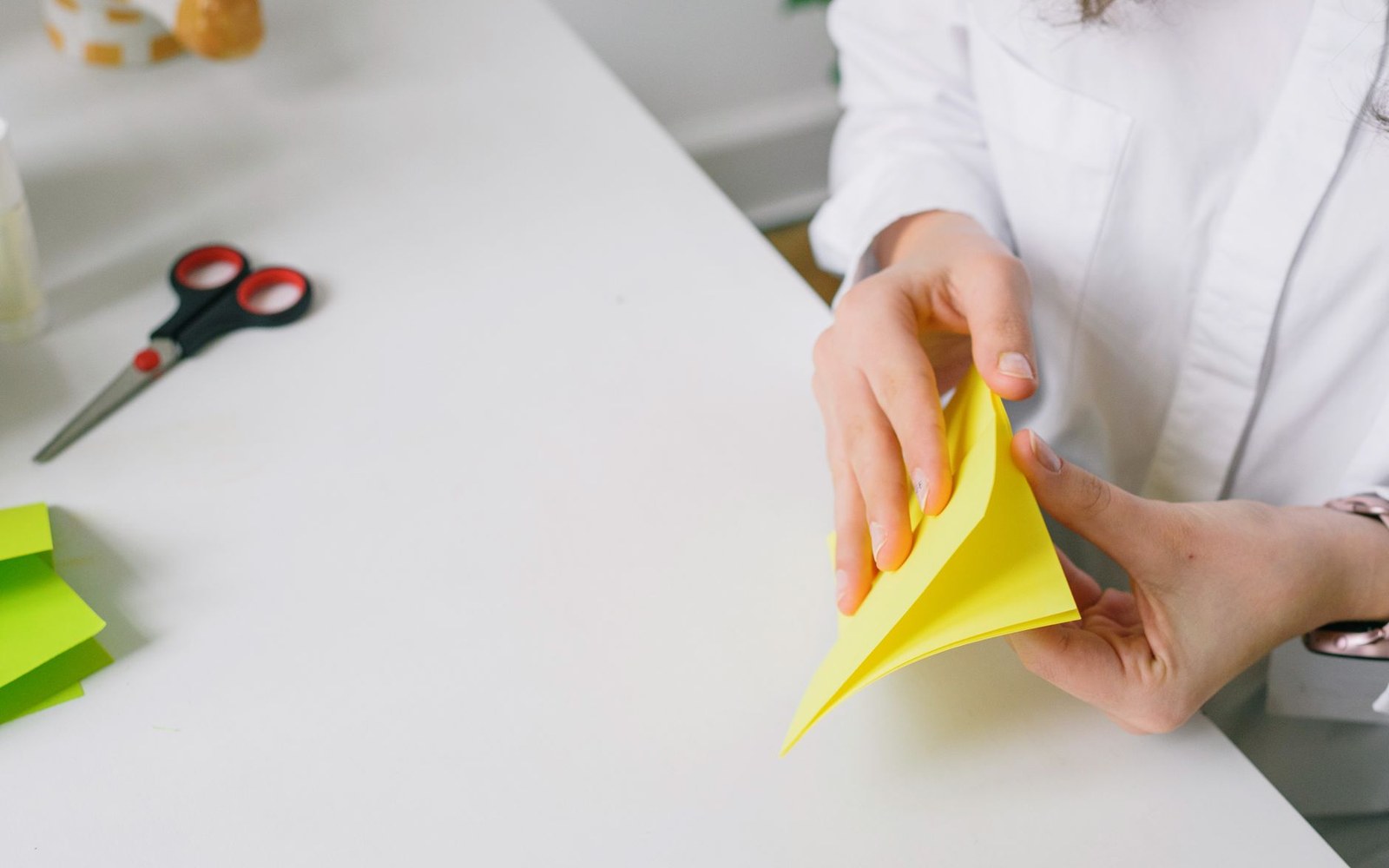
Two other formats deserve mention, though they appear less frequently in distro boxes.
The accordion fold — sometimes called a concertina — divides the sheet into an even number of panels folded alternately forward and back, like the bellows of the instrument it is named for. A single letter sheet folded into six panels gives a format that can be read sequentially like a strip or opened fully to reveal a single panoramic image across the whole interior. Illustrators and cartoonists use it for wordless narratives. The accordion does not bind and does not staple; the panels simply hold their shape by tension. It is, in structural terms, one of the most fragile formats — a broadsheet folded once, then folded again and again — but also one of the most visually striking when fully extended. Keeping it shut for transport is a minor challenge: a belly band, a rubber band, or a short length of ribbon will do the job.
The broadsheet, at the opposite end of the scale, is the sheet printed on both sides and folded once, producing a large-format four-page document that opens like a newspaper. This is not a booklet format in any usual sense — it is a single sheet that happens to fold — but it appears often enough as a special insert, a map, or a standalone announcement that it belongs in any maker's repertoire. A number of longer-running zines have used broadsheet inserts stapled loosely into a saddle-stitched issue, creating a visual surprise when the reader reaches the middle of the booklet and something large unfolds out of it.
One practical note that applies across all these formats: grain direction matters more than makers often realize. Paper has a machine grain — the direction in which the fibres ran through the manufacturing process — and folding against the grain produces a rougher, slightly cracked fold line. For short photocopied runs this rarely matters enough to worry about. For a risograph-printed edition where the fold line will be visible on a coloured stock, grain direction is worth checking. Most copy paper is long-grain — meaning the grain runs parallel to the long edge — which means that a hamburger fold (folding along the long axis, bringing the short edges together) folds with the grain, producing a clean crease. A hot-dog fold (bringing the long edges together) folds against the grain. This is not a crisis, but it is the kind of thing that separates a zine that feels good in the hand from one that does not quite.
All of these formats are, fundamentally, negotiations between a flat rectangle and the human hand. The photocopier, the paper, and the fold are the whole material vocabulary of a form that has been working with these constraints, and finding freedom inside them, for as long as people have had access to a copy machine and a sheet of letter paper.