Make One in an Hour
From blank sheet to stapled object: a genuine walkthrough
The Hour
Three passes, eleven moves, one stapled object. Tick as you go — the page remembers where you got to.
Make the content
Impose & copy
Fold, collate, staple
a third in
from each end
You do not need a printer you own, a design program you understand, or a plan that survives contact with the page. You need paper, a photocopier, a stapler, and about sixty minutes. What follows is a real sequence — the one that produces a finished, holdable, readable zine by the end of the hour.
What you are making
The format is half-letter: one sheet of letter paper folded once, producing a four-page booklet roughly 5.5 by 8.5 inches. If you have more to say, you add sheets — two sheets give you eight pages, three give twelve — and you bind them by stapling through the fold. That binding is saddle stitch, and it requires nothing fancier than a standard stapler if the page count is low, or a long-arm stapler for anything thicker.
Before you pick up a pen, decide on page count. For a first zine in an hour, one or two sheets is realistic. Two sheets, folded together, gives you eight pages including covers. That is enough for a short essay, a set of drawings, a list that means something, a recipe with notes, a dream you wrote down. Fix the number before you start; changing it mid-session costs time you do not have.
The first thirty minutes: make the content
A genuine walkthrough, start to stapled.
Formats & Binding
Lay your sheets flat and number the panels before you fill them. On a single folded sheet, the panels run: back cover (panel 1), then inside left, inside right, then front cover (panel 4) — though how you orient them on the unfolded sheet before copying is a separate question dealt with below. For now, just know which panel is which.
Work analog if you can. A photocopier does not care whether your content was made in a design program or drawn with a ballpoint pen on a grid-ruled page; it cares about contrast. Black ink on white paper copies cleanly. Light pencil, grey marker, or anything that hovers around middle grey will muddy or vanish. If you are drawing, use the darkest pen you own. If you are typing, print at the highest toner density your printer allows.
Spend the first thirty minutes making the actual content — no layout decisions, just filling the pages with what you want them to hold. If you are writing, handwrite directly onto the panels or type and print a rough paste-up. If you are drawing, draw. A hand-lettered title on the front cover, a short text or image sequence inside, your name and a rough print-run note — a colophon — on the back. That is a complete zine. Keep it simple: a first issue that exists is more useful than a second issue planned in detail.
The second fifteen minutes: imposition and copying
This is the step most first-timers skip, and it is why their pages come out in the wrong order. Before you copy, you need to arrange your content so that when the sheet is printed double-sided, folded once, and cut or left intact, the pages read in sequence.
For a single-sheet, four-page half-letter zine, the front cover and back cover print on one side of the sheet, and the two inside pages print on the other. The front cover sits to the right of center on its side; the back cover sits to the left. On the reverse, inside-left and inside-right swap accordingly. The exact orientation depends on whether your copier flips on the long edge or the short edge — test this with a scrap sheet and a pencil mark before you commit.
For a two-sheet, eight-page booklet, you do the same calculation twice. Page 8 and page 1 share one side of sheet one (the outer sheet). Pages 2 and 7 share the reverse. Pages 6 and 3 share one side of sheet two (the inner sheet). Pages 4 and 5 — the center spread — share its reverse. If those numbers feel complicated, draw a small thumbnail diagram of the folded booklet and number each panel; then unfold it mentally to see where each panel lands on the flat sheet. Two minutes with a pencil saves a ruined copy run.
Make your copies. For a short run — ten, twenty, thirty copies — a library or copy-shop machine is entirely adequate. If you are using someone else's machine, bring your originals flat in a folder, bring exact change, and know your page count before you queue. Copy single-sided first onto scrap to check orientation, then run your real stock. Use the lightest paper weight that feeds reliably through the machine; most copy-shop machines are happy with standard 20 lb bond, and it folds cleanly.
The last fifteen minutes: fold, collate and staple
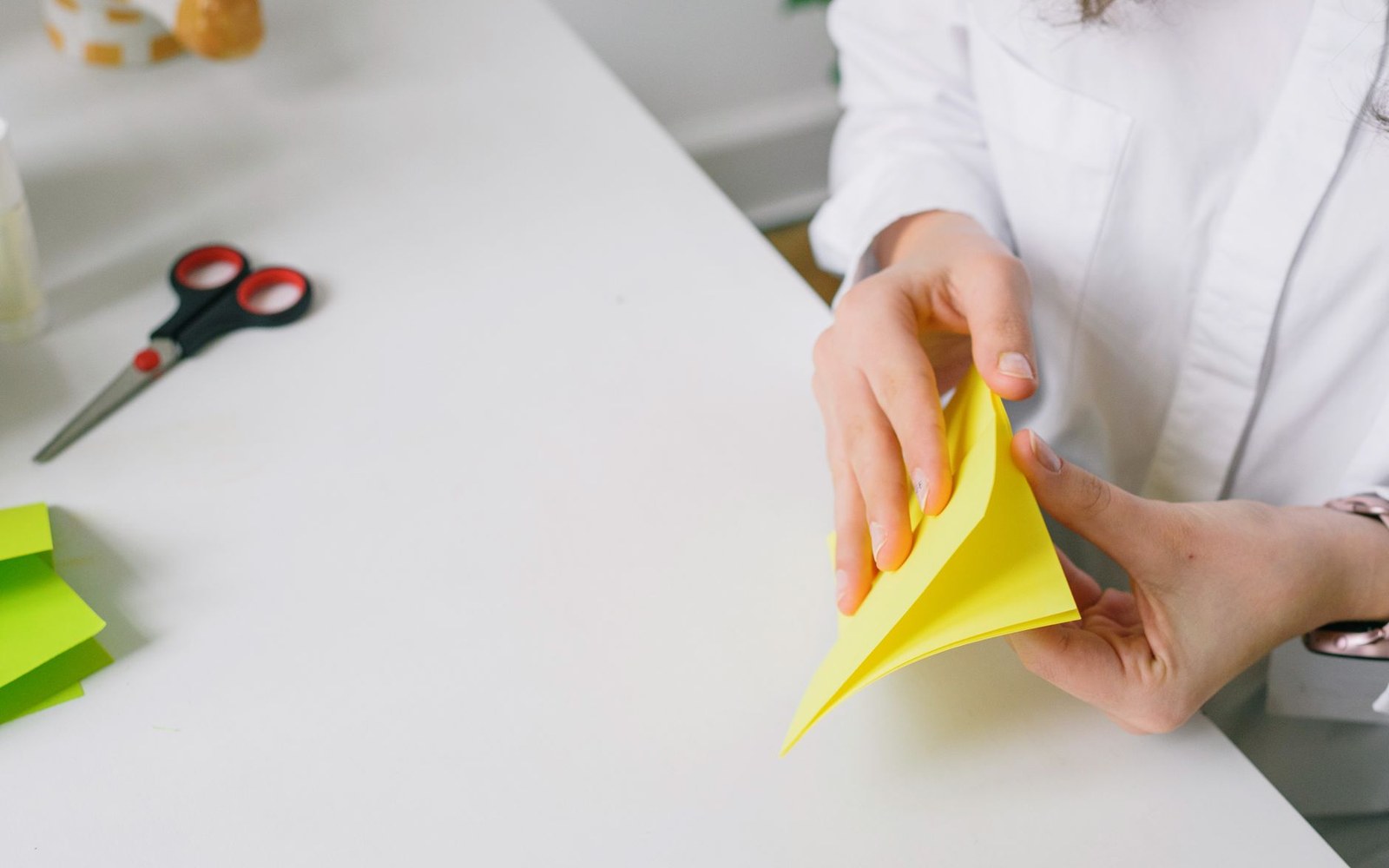
Stack your printed sheets in order — outer sheet on the outside, inner sheet nested inside. Fold them together along the center line, pressing the fold firmly with your thumbnail or a bone folder if you have one. The fold wants to be clean and consistent; a ragged fold makes the pages shift and the staple miss its mark.
Staple through the spine. For a one- or two-sheet zine, an ordinary desk stapler can reach the fold if you open it flat and press down with the spine of the booklet against a piece of thick foam or a stack of scrap paper — the staple pushes through and you fold the legs down on the inside by hand. It is fiddly but it works. A long-arm stapler, which extends its reach to twelve or more inches from the paper edge, does this without the gymnastics. If you are making more than a handful of copies and plan to keep making zines, a long-arm stapler is the one tool worth buying.
Two staples per spine, placed roughly a third of the way from each end, hold a thin booklet securely. Trim the fore-edge if your sheets are slightly misaligned — a metal ruler and a craft knife against a cutting mat gives a clean edge — but honest hand-folding rarely needs it.
What you have now
A finished object. It has a front cover and a back cover, a spine, pages that read in sequence, and your name on it somewhere. If you wrote a colophon — who made it, when, in what run, on what machine — it is a complete, self-documenting artifact. If you did not, write one by hand in the copies before you distribute them; a zine without a colophon is an unnamed thing.
The hour is a real constraint and a useful one. It prevents the slow perfectionism that keeps zines from existing. It also teaches you the format's logic faster than any tutorial, because you encounter every problem — imposition, contrast, fold, staple — in sequence, in miniature, with low stakes. The next one will take forty-five minutes. The one after that, thirty.
Number this issue. Not because you have already planned the next one, but because calling something Issue 1 is an act of optimism, and optimism is part of the form.